

Friday, September 18th 2026
Tapcart Alternative: NAPPS Pricing, Features & Migration
NAPPS is a Tapcart alternative for Shopify brands that want native shopping screens, Klaviyo on every plan, and custom components built with Expresso. Tapcart is worth keeping when its experimentation tools or integrations are essential to your app. Compare the requirements below, then check the pricing, feature details, and migration steps before deciding.
The short answer
| Consider NAPPS if... | Keep Tapcart if... |
|---|---|
| You want shopping screens built with SwiftUI and Jetpack Compose, including custom UI built with Expresso. | You rely on built-in A/B testing. Tapcart includes it on Scale; NAPPS does not offer A/B testing. |
| Klaviyo is central to your app marketing. NAPPS includes it on every plan, from $299/month. Tapcart labels its Klaviyo integration Enterprise Only. | Your app depends on Attentive, Braze, Iterable, or another integration NAPPS does not support. Check the Tapcart plan required for each integration. |
| Your developer needs to build custom native components. Expresso is included on every plan; development work is scoped separately. | Your team needs unlimited screens assembled from Tapcart components. Tapcart includes these on Growth; NAPPS caps custom pages below Enterprise. |
| You have a specific gap to solve and want to test NAPPS with your real catalog. Building and testing are free until you publish. | Your current app meets your requirements and switching has no clear benefit. Compare the rebuild effort and migration costs before moving. |
We are NAPPS, one of the providers compared here. These recommendations are our assessment of fit; the detailed comparisons below link to the evidence and explain the limits of our research.
Every Tapcart figure and feature on this page was checked on 18 September 2026 against the page it links to, across tapcart.com, its developer documentation, its published SDK, and both Shopify App Store listings. We checked Tapcart's prices, its Klaviyo plan label, and its App Store listing again on 12 October 2026, and none had changed. Feature availability varies by plan and prices are monthly. We date the two things that move fastest, pricing and plan gating, wherever they appear. Re-check both vendors' live pages before you sign anything.Which other Tapcart alternatives should you consider?
If you are comparing several Tapcart competitors, start with the requirement that matters most to your store. Our broader Shopify app-builder comparison covers these options in more detail.
- Consider MobiLoud if you want to reuse your existing mobile website and its functionality inside an app. Check the setup fee and test your shopping flows.
- Venn Apps offers managed design and implementation for a bespoke native app. Confirm what the service includes and how later changes are handled.
- OneMobile has the lowest starting subscription in our shortlist. Include its app-revenue fees when comparing the total cost.
See the full Shopify mobile app-builder comparison for pricing, implementation responsibilities, and the tradeoffs of each option.
Why brands consider a Tapcart alternative
Not every Tapcart customer has a reason to leave. These are the five that bring people to this page, and each is a requirement rather than a complaint.
- Screens that have to feel native. Not only the configurator or the video feed: the cart, the product listing, and search. We inspected nine live Tapcart-built apps on Android in September 2026 and the same nine on iOS in October 2026, and found all of those screens rendering as web content.
- Plan economics against a real requirement. The published entry price is $500/mo, but the plan you need depends on the capability you need. Klaviyo moves that floor to Enterprise+. A/B testing moves it to Scale.
- Integration depth in one slot. Tapcart's directory is larger than ours, but 12 of its integrations carry an "Enterprise Only" label on their own pages. Directory size and directory access are different questions.
- Seats and operational control. Tapcart's Growth plan lists "One team member account"; full team access starts on Scale at $1,250/mo (Tapcart pricing). NAPPS gives every plan unlimited seats, because app login runs through Shopify.
- The cost of switching itself. Usually the real blocker, so it gets its own section below.
Tapcart alternative at a glance: NAPPS vs Tapcart
Nine rows decide most of these evaluations. Plan conditions are stated inline, and a claim about Tapcart carries the source that backs it. Anything qualitative is labeled (our assessment).
| Decision criterion | NAPPS | Tapcart |
|---|---|---|
| Standard app architecture | Fully native: SwiftUI on iOS, Jetpack Compose on Android | A native shell around web content. In the same nine live Tapcart-built apps, inspected on Android in September 2026 and on iOS in October 2026, the cart, PLP, search, profile, quick add, hamburger menu, and home components all rendered as web content. On iOS they were pages served from tapcart.studio |
| Custom-screen rendering | Custom components are written in TypeScript and compiled to native SwiftUI and Compose, with no web layer | Also web. Custom Blocks and Custom Screens run through the Web Bridge SDK, whose npm package describes itself as a bridge "between the native iOS/Android Webviews and the Web Apps built by the merchants" (@tapcart/app-studio-sdk v2.3.0, published 24 Aug 2026) |
| Operator tooling | Builder handles routine merchandising with no engineering. Unlimited design blocks and unlimited seats on every plan | App Studio, with unlimited blocks on every plan. One seat on Growth, full team access on Scale. Conditional visibility, metafields, and screen scheduling on Scale (pricing) |
| Custom app screens | Limited by plan: 1 custom page on Business, 3 on Scale, unlimited on Enterprise. Page layouts are capped the same way below Enterprise | Unlimited on every plan, assembled from Tapcart's own components in App Studio (pricing) |
| AI tooling | No AI content or AI push product | An App Studio AI agent is included on every plan. The marketing AI (AI push, Autopilot, AI Scenes, Gen AI video) is a separate $250/mo add-on, not included in any tier (pricing) |
| Developer access | Expresso, our TypeScript-to-native layer, plus the napps CLI, a component library, an app-extension library for product, cart and collection logic, and an authoring skill for AI-assisted builds. Included on every plan. No plan gate | Custom Blocks, Server Functions, Developer Tools, Agent MCP, and the Tapcart CLI are all Enterprise+, from $2,850/mo (pricing) |
| Integrations | Klaviyo on every plan; Ometria on Enterprise. Roughly two dozen third-party integrations plus six Shopify-native surfaces. No Attentive, Braze, Iterable, or data-warehouse streaming | Larger directory: 67 live partners, counted card by card in July 2026. 12 carry an "Enterprise Only" label on their own pages, including Klaviyo, Ometria, AppsFlyer, and Branch |
| Minimum relevant price | $299/mo for a standard app. $299/mo with the developer layer. $299/mo with Klaviyo | $500/mo for a standard app. From $2,850/mo for developer tooling. From $2,850/mo with Klaviyo. $1,250/mo for A/B testing and heatmaps |
| Migration support | App stays free until you publish, and the remaining months on your current contract are matched free | 7-day free trial. No published switching offer |
Two rows go against us and are worth reading twice. Tapcart gives unlimited custom app screens on its entry plan while we cap them below Enterprise, and it has an AI content suite where we have none. Against that, its unlimited screens are assembled from Tapcart's own components, which is a different thing from writing your own code. That distinction is the next section.
The architecture distinction, stated precisely
React Native is not a webview. It renders real native UI widgets through a JavaScript bridge, and any article that calls React Native a webview framework is wrong. Hold that distinction, because it is the one most comparison articles get wrong in the other direction.
The question that matters is narrower: what does this vendor actually render its commerce screens with? A screen ends up as one of two things. Compiled native UI, written in SwiftUI or Jetpack Compose and running on the device. Or an embedded WebView surface, where HTML, CSS, and JavaScript render in a browser frame inside the app, with web-style scrolling and a slower first paint.
You do not have to take anyone's word for which one you are looking at. On Android, a WebView with debugging enabled appears on Chrome's chrome://inspect page while the app runs. On iOS, inspectable web content appears under your iPhone in Safari's Develop menu. When a screen's content shows up there, that screen is rendering web content. It is a direct reading, not an inference from how the scrolling feels. The reverse does not hold: an app decides which web views it exposes, so an empty list proves nothing either way.
We ran that check on the same nine live Tapcart-built apps, on Android in September 2026 and on iOS in October 2026. On both platforms, the cart, product listing, search, profile, quick add, hamburger menu, and home components rendered as web content. In the iOS app we traced screen by screen (version 10.8, iOS 26.6.2), the cart, the full product page from its image and video gallery down to the add-to-cart button, the account tab, the collection screen, and the home tabs were each a page of a Next.js web app served from tapcart.studio. Only the shell around them, the status, navigation, and tab bars, was native. The sample mixed large and small brands. It is nine apps, not every Tapcart build, and it shows how those screens render, not how fast they load.
So the accurate description, for the apps we inspected, is a native shell around web-rendered commerce screens. Run the check yourself before you accept that from us, on your own app or a competitor's: it takes about ten minutes and the method is in is my Shopify app a webview?.
On NAPPS, a custom component is written in TypeScript through Expresso and compiled to SwiftUI and Compose. There is no web layer underneath it. We say that from how NAPPS builds the screens, not from an empty inspector, because an empty inspector cannot prove that a screen is native.
On Tapcart, the answer comes from Tapcart. Its developer platform page describes Custom Blocks as supporting "HTML, CSS, & Javascript" and the Web Bridge SDK as giving you the "Capability to embed a react web-app" (Tapcart developer tools; that page still names Tapcart's retired Core and Ultimate plans, so read it for capabilities, not prices). The SDK ships on npm as the "Tapcart WebBridge React SDK", and its README says it "acts as a communication bridge between the native iOS/Android Webviews and the Web Apps built by the merchants" (@tapcart/app-studio-sdk, v2.3.0, published 24 August 2026). That is their current release, not a legacy artifact.
The newer CLI toolchain does not change that. Blocks are authored as JSX, and the component library @tapcart/app-studio-components is documented with examples returning div and h2 elements. Those are DOM nodes. The toolchain is nicer to write in than raw HTML; the output is still a web app in a WebView.
None of this makes Tapcart a bad platform, and plenty of brands ship well on it. It does mean the label is doing more work than the architecture is (our assessment). To check what your current app does, the five-minute on-device test in is my Shopify app a webview? works on any platform. For a practical example, see Planeta Huerto's native components.
What each platform costs for the same requirement
Comparing $299 against $500 tells you almost nothing, because the plan you need depends on the capability you need. Here are three real requirements, priced against the minimum plan on each side. All figures are monthly, checked 12 Oct 2026.
Requirement 1: a standard Shopify app. Native storefront screens, unlimited push, your existing loyalty and reviews providers, operator-managed merchandising.
- NAPPS: Business, $299/mo. Unlimited seats.
- Tapcart: Growth, $500/mo. One team member account; a second person in the editor moves you to Scale at $1,250/mo.
Requirement 2: analytics and targeting. This one splits, and the split is the most useful thing on this page.
- If the requirement is in-app A/B testing, Tapcart wins outright at Scale, $1,250/mo. NAPPS cannot meet it at any price, because we do not offer A/B testing on any plan. If experimentation is how your team works, stop reading and buy Tapcart Scale. Segmentation and heatmaps are closer than that: on NAPPS they come through Klaviyo segments and Microsoft Clarity rather than as in-app platform features, which is a real difference in convenience but not in capability (our assessment).
- If the requirement is Klaviyo-driven push, segments, and event tracking, NAPPS meets it on Business, $299/mo, because Klaviyo is on every plan. On Tapcart, Klaviyo's own integration page is labeled "Enterprise Only", which puts the same requirement at Enterprise+, from $2,850/mo. Ometria carries the same label; on NAPPS it needs Enterprise at $999/mo.
Read both halves. One is a clean Tapcart win, one is a 9x price difference in our favor, and which applies to you depends on whether your app marketing runs inside the app platform or inside your CRM.
Requirement 3: custom developer-built screens.
- NAPPS: $299/mo. Expresso is included on every plan, so the developer layer is available from the entry tier. You get the
nappsCLI for scaffolding, building and deploying components, a TypeScript component library, a separate library for product, cart and collection logic, merchant-facing settings your components declare themselves, and an authoring skill so an AI agent can build against the libraries. The output compiles to native SwiftUI and Jetpack Compose. - Tapcart: from $2,850/mo. Custom Blocks, Server Functions, Developer Tools, Agent MCP, and the Tapcart CLI are all Enterprise+. The toolchain is comparable in shape: a CLI, a component library, an agent integration. The output is a web app rendered through the Web Bridge SDK.
The toolchains are more alike than the prices suggest, so the two things to compare are the gate and the output. The gate is $299/mo against $2,850/mo. The output is compiled native UI against a web document in a WebView. Neither of those is a small difference, and they point the same way.
Three cost lines sit outside every pricing page and are usually larger than the subscription gap: the build cost of your custom work, the hours your team spends running the app each month, and the cost of replatforming again if the architecture caps you in year two. Both platforms need an Apple Developer account at $99/year and a Google Play registration at $25 one-time, which is not a differentiator either way. Check your own contract for a percentage-of-revenue success fee too. Tapcart dropped its former fee for new 2026 contracts, legacy contracts may still carry one, and NAPPS does not charge one. Use the Shopify mobile app ROI calculator to compare your own assumptions.
Integrations: directory size against your actual stack
Tapcart's directory is bigger than ours, and that is the right place to start. A card-by-card count in July 2026 found 83 partners, 67 of them live, covering categories we do not offer at all: buy-now-pay-later, live selling, pre-orders, quizzes, referrals, try-before-you-buy, and virtual try-on. If your app depends on one of those, Tapcart is your answer and the rest of this section will not change that.
For everyone else, directory size is the wrong measure. What decides your bill is which plan unlocks the tools you already run. Here are the seven slots most Shopify brands need to fill.
| Stack slot | NAPPS | Tapcart | Stronger |
|---|---|---|---|
| Email, SMS, CRM | Klaviyo on every plan: push, profile identification, event tracking, in-app forms, deep links. No geofencing. Ometria on Enterprise. No Attentive, Braze, or Iterable | All five available. All five labeled "Enterprise Only" on their own pages, so Klaviyo means Enterprise+ from $2,850/mo | NAPPS, on price of entry |
| Loyalty | LoyaltyLion, Smile, Growave Loyalty, every plan, rendering as native screens | Longer list, including Rivo, Yotpo Loyalty, Okendo | Tapcart on breadth (our assessment) |
| Reviews | Judge.me, Yotpo, Stamped, Growave, Trustpilot, every plan | Longer list, including Loox, Junip, Reviews.io | Parity in practice (our assessment) |
| Subscriptions | Recharge and Rebuy, every plan | Recharge as an Elite Partner, plus Stay Ai. Skio is Enterprise Only | Tapcart at scale (our assessment) |
| Search | Doofinder and Searchanise, with Shopify Storefront API search as the default | Six providers, including Algolia and Nosto | Tapcart (our assessment) |
| Analytics | GA4, Firebase, Microsoft Clarity, plus a built-in dashboard that reports per-send push attribution within 12 hours of a send. AppsFlyer is coming soon, not live | Comparable tool coverage. AppsFlyer and Branch are Enterprise Only. Data-warehouse streaming on Enterprise+, which we do not offer | Depends on your stack (our assessment) |
| Customer support | Gorgias | Gorgias, Zowie, Rep.Ai | Tapcart (our assessment) |
Tapcart takes three of the seven outright and ties one. The row that tends to decide the bill is the first, because push driven by your CRM is what most brands buy an app for.
So check the gate, not the logo. Open the vendor's own integration page for each tool you run and read the plan label on it. On Tapcart those labels live on the integration pages rather than the pricing page, which is how the published entry price and the real entry price for a CRM-driven app end up being $500 and $2,850.
What switching to a Tapcart alternative actually involves
This is the part that decides whether you move, and most comparison articles skip it.
Start with one question, because everything else depends on the answer: who owns your app? If your App Store Connect and Google Play accounts are yours and your Android signing path is available, the new build ships as an update to your existing listing, and your store record carries over. If the app lives in your current provider's account, it has to be transferred to you first, and a transfer has its own conditions.
Both stores support the transfer, with limits worth knowing before you plan anything. Apple's App Store Connect documentation on transferring apps says a transfer can keep the bundle ID, reviews, ratings, and update continuity, but eligibility criteria apply and users have to sign in again afterwards, because the receiving account cannot retrieve the old keychain token. Google Play Console Help says a Play transfer moves users, ratings, reviews, and store-listing information, but not reporting, test groups, or some integrated-service permissions and linkages.
So "you lose nothing" is too strong, and you should be suspicious of anyone who says it. What holds is narrower: you keep the installed base and the store record, and some connective tissue needs deliberate handling.
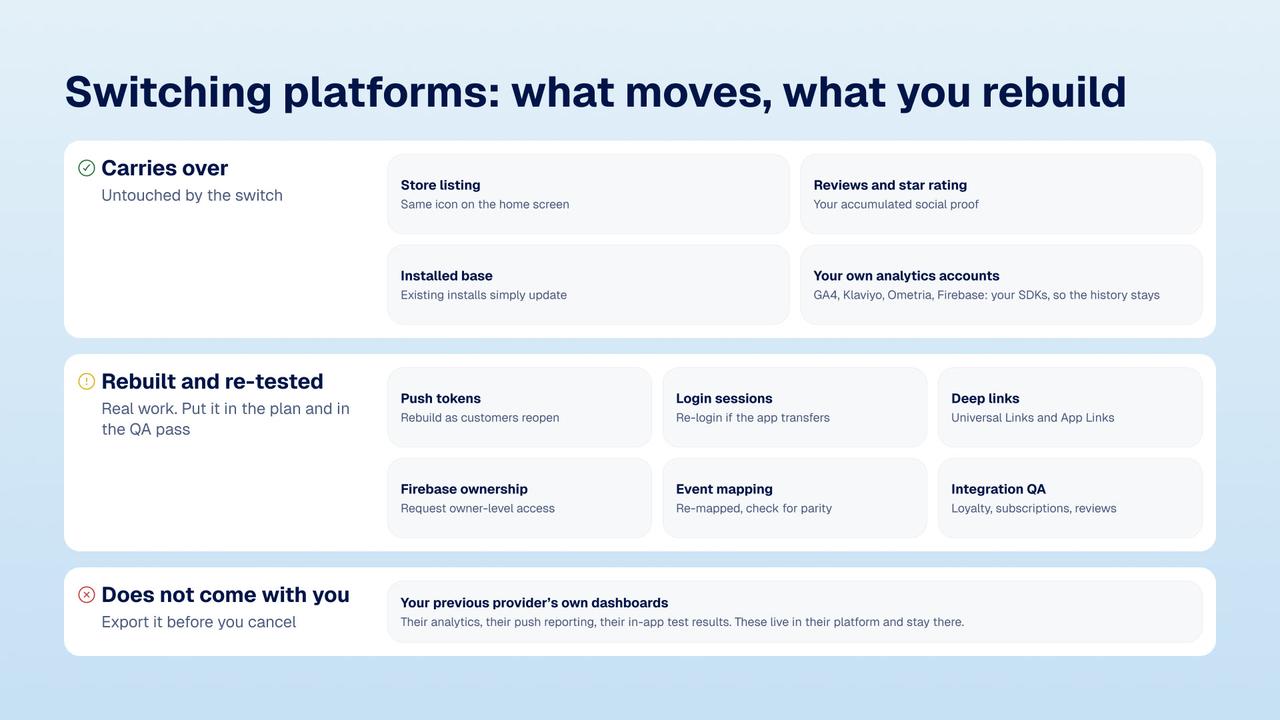
What carries over, once that ownership question is settled:
- Your App Store and Play listing, your icon, and the app already on your customers' home screens.
- Your reviews and your accumulated star rating. If your previous app dragged your score down, Apple also lets you request a summary-rating reset when you publish a new version, which is a judgment call rather than a free win.
- Your installed base. Existing installs update to the new build.
What gets rebuilt or re-established, and needs to be in the project plan:
- Push permissions and tokens. Push tokens do not transfer between providers. They rebuild as customers open the new app, so confirm your opt-in base and plan for the gap.
- Login sessions. If you already own the account, this is a version update and sessions come down to your authentication mapping. If the app is transferred, plan for the forced re-login described above and tell your customers before it happens.
- Deep links. Universal Links and App Links, plus any deferred links in your paid campaigns, get re-mapped and tested on real devices.
- Firebase ownership. The initial Firebase project is usually owned by your previous provider. You request owner-level access, and we handle the migration from there.
- Analytics: your own tools move, the provider's dashboard does not. Split these two, because they behave completely differently. GA4, Klaviyo, Ometria, Firebase and the rest are your accounts and your SDKs, so they reconnect and the history in them is untouched. Your event stream still gets re-mapped and checked for parity, but nothing is lost. Tapcart's own analytics is a different story: it does not come with you. Insights dashboards, its push reporting, and its in-app A/B test results live in Tapcart and stay there. Export anything you need as a baseline before you cancel, because after that it is gone. The same is true in reverse if you ever leave us.
- Integration QA. Loyalty balances, subscription states, and review displays get validated before launch, not after.
On timing: you build and test the native version before you publish, so there is no gap in service, and NAPPS matches the remaining months on your Tapcart contract so you are not paying two vendors during the move. The app stays free until you are ready to publish.
Who should choose which
Choose Tapcart if:
- You run experiments. A/B testing, user segmentation, heatmaps, and scrollmaps are listed on Scale at $1,250/mo, all inside the app platform. NAPPS has no A/B testing at any tier, and reaches segmentation and heatmaps through Klaviyo and Microsoft Clarity instead.
- You need a category we do not cover, or a warehouse feed. Live selling, buy-now-pay-later, quizzes, virtual try-on, try-before-you-buy, or data streaming to a third-party data warehouse. Each is on Tapcart's list and none is on ours.
- You want a platform with a longer review record. Tapcart's Shopify App Store listing shows 4.7 stars across 341 reviews, checked 12 October 2026; ours shows 5.0 across 35. A review count is not an install count or a quality ranking, but 341 reviews give you more first-hand accounts from other Shopify brands to read before you sign.
Choose NAPPS if:
- You want the commerce screens themselves to be native. Cart, product listing, search, and profile compiled to SwiftUI and Jetpack Compose, along with anything custom you author in TypeScript. On the nine Tapcart apps we inspected on Android and iOS, every one of those surfaces was web content.
- Klaviyo is central, or you need more than one seat. Klaviyo on every plan from $299/mo, against an "Enterprise Only" label on Tapcart's own Klaviyo page. Unlimited seats on every plan, against one seat on Tapcart Growth.
- You are mid-contract. We match your remaining months for free and the app stays free until you publish, so a switch does not mean paying two vendors. Tapcart publishes no equivalent offer.
One signal to check yourself rather than take from us: Shopify awards the Built for Shopify badge against its own performance, design, and integration standards. NAPPS carries it on its listing, and Shopify revalidated it on 7 October 2026. Tapcart's listing does not show it, checked 12 October 2026. Tapcart is a Shopify Plus Certified App Partner, a separate program that we do not hold. Two credentials, both real, checked on both listings.
The evidence behind the native claim
We will not show you a "3x conversion" screenshot, ours or anyone's. Every figure below compares the app channel with the online storefront on the same catalog. App users are self-selected and no holdout was run, so none of these proves the app caused the difference. They show how the two channels compared in a window that followed an architecture change, which is the weaker and more honest claim.
- Planeta Huerto rebuilt its app with NAPPS, moving from a webview app to a native build on the same catalog. In the first 90 days after that rebuild, its app customers spent +47% more each than its online storefront customers, and repurchased at 72% on the app. Based on NAPPS customer data, app channel against online storefront. Note what that is and is not: a comparison between two channels over the same window, not a before-and-after measurement of the same customers. The six custom product-page components behind it are documented in how Planeta Huerto rebuilt six native product-page components.
- Missus has been on NAPPS since 2021, and the app still runs about 30% of online revenue. Over the trailing 365 days, app customers spend +47% more each and return at 44.20% against 33.63% on the storefront. This is our only proof point measured in years rather than months, and the one that answers "does this still work in year five".
- Zippy sees the app convert about +370% against mobile web, with roughly 34% of total online revenue flowing through the app, measured July 2025 to February 2026. Note the basis: that is app against mobile web, not app against all web traffic.
Across NAPPS customers, every tracked brand shows a positive average order value difference, and typical lift in spend per customer is about 47%. None of this proves Tapcart cannot ship a good app. Hold every vendor, us included, to stating what it measured and over what window.
Tapcart alternative FAQ
It depends on the requirement. A standard app is $299/mo on NAPPS Business against $500/mo on Tapcart Growth. Custom developer work is $299/mo on NAPPS against Tapcart's Enterprise+ floor of $2,850/mo, where the CLI and Developer Tools are listed. Klaviyo is $299/mo on NAPPS against that same Enterprise+ floor. Tapcart is the cheaper answer for in-app A/B testing, at $1,250/mo, because NAPPS does not offer it at any price. All prices monthly, checked 12 Oct 2026.
Its app shell is native, but in the apps we inspected its shopping screens were web content. We checked the same nine live Tapcart-built apps on Android in September 2026 and on iOS in October 2026. The cart, product listing, search, profile, quick add, hamburger menu, and home components all rendered as web content, and on iOS they were pages of a Next.js web app served from tapcart.studio. Its developer tooling points the same way: the Web Bridge SDK's npm package describes itself as a bridge between "the native iOS/Android Webviews and the Web Apps built by the merchants". So the accurate answer is a native shell around web-rendered commerce screens, in nine apps rather than every build. You can check an app yourself in about ten minutes with chrome://inspect on Android or Safari's Web Inspector on iOS. A screen that appears there is web content. An empty list proves nothing, because each app decides which web views to expose.
Not inherently. React Native renders genuine native UI widgets through a JavaScript bridge. It is not a webview framework. But any React Native app can embed a WebView for specific screens, and app builders differ in whether their custom-content path does. Ask per screen type, not per platform.
You keep your store listing, your reviews and star rating, and your installed base, because the new build ships as an update to the existing listing rather than as a new app. That holds provided you own your Apple and Google accounts and your Android signing path is available. Push tokens, deep links, login sessions, Firebase ownership, and your analytics event mapping do get rebuilt. Anyone promising that nothing changes has not read Apple's transfer documentation.
Our documented range for a standard build is go live in week 3 to 4, sequenced as setup, configuration, review and QA, then submission. Treat that as the shape of the process rather than a date you promise your customers, because three things move it: how much custom work is in scope, whether the app has to be transferred into your accounts first, and store review. Apple reviews most submissions inside 24 hours but a rejection resets the clock, and Google can take up to seven days or longer. You do not run a gap, because the native version is built and signed off before it publishes. And you do not pay twice. NAPPS matches the months left on your Tapcart contract for free, and your app stays free until you publish.
The bottom line
Three questions settle this, and none is a feature count. Where does your UI render when you customize it? What is the minimum plan that covers your actual stack on each side? And what does the migration rebuild? Answer those from the vendors' own pages and you will not regret either choice.
If native custom screens are where your brand competes, the fastest way to settle it is to hold one. We will build your store as a native app on your real catalog so you can run the on-device test yourself first. The app is free until you publish, and if you are switching, the remaining months on your current contract are on us.
See a native build on your own catalog
We build your store as a native app on your real catalog, so you can run the on-device WebView check yourself before you decide anything. The app is free until you publish, and if you are switching, we match the months left on your current contract.
Book a 20-minute callKeep reading
October 27, 2026 - 10 min read
4 MobiLoud alternatives for Shopify: pricing and fit


October 23, 2026 - 8 min read
Tapcart vs Shopney: pricing, features, and which fits your Shopify store
September 11, 2026 - 16 min read
Klaviyo push notifications for Shopify mobile apps
