

Monday, September 21st 2026
Can you sell CBD, cannabis, or vapes through a mobile app?

If you sell a regulated product, the first question isn't "how do we grow an app," it's "will the stores approve one, and is it lawful to do this in our markets?" Those are two separate questions, and for cannabis, CBD, vape, and nicotine brands both have to be answered before a single screen gets designed.
This guide lays out what Apple and Google publicly say for these categories, what their policies leave undefined, and what you need to pin down before building. It is written to help you ask the right questions, not to answer them for your specific products.
Scope, and what this is not. Store acceptance and legal compliance are separate decisions. This guide does not determine whether a product is lawful to market, sell, ship, or advertise in any jurisdiction, and it does not guarantee App Store or Google Play approval. It is not legal advice. These policies change frequently and vary by country, and local law sits on top of them. Verify current policy with each store and take qualified legal advice before acting.
What you need to establish first
Regulated-product review turns on specifics. A brand cannot get a useful answer from a store, counsel, or us without establishing all of these:
- Exact product composition, including whether anything contains THC, and at what level.
- Every jurisdiction you would sell, deliver, or ship to through the app.
- Seller and dispenser licensing you hold in each of those jurisdictions.
- Age-verification and ID-check requirements that apply to you.
- What the app actually does: purely informs, promotes products, links out, takes an order, or arranges fulfillment. These are very different from a policy standpoint.
- Written confirmation from the relevant app-store policy team wherever your model is borderline. For regulated categories, a written determination is worth more than any general guide, including this one.
If you cannot answer these yet, do that work before design or build. For the wider evaluation questions every Shopify brand should answer before choosing a platform, see how to evaluate a Shopify mobile app platform.
The decision table
For each category, separate what the platforms publicly state from what they leave undefined, and treat the third column as required homework rather than optional.
| Category | What the platform rules say | What the policy does not settle | Action before building |
|---|---|---|---|
| Marijuana / THC | Apple (Guideline 1.4.3) allows facilitating the sale of controlled substances only for licensed pharmacies and licensed or legal cannabis dispensaries, and (5.1.1(ix)) requires a legal-entity submitter and geo-restriction to the legal jurisdiction. Google does not allow apps that facilitate the sale of marijuana or marijuana products, regardless of legality (carts, delivery, pickup, and THC-containing CBD are named examples). | Whether your licensing, markets, age-checks, and fulfillment satisfy either store. Whether any non-transactional model is acceptable. | Get a written policy determination from each store for your exact model, alongside legal advice. |
| CBD / hemp | Neither store publishes a CBD-specific test. Google explicitly folds CBD products that contain THC into its marijuana restriction. Treatment of genuinely THC-free CBD is not defined in these policies. | Whether a THC-free product is treated as ordinary retail or as restricted. This is not stated. | Separate THC-containing from THC-free products, and confirm treatment in writing rather than assuming. |
| Vape / e-cigarettes / nicotine | Both stores prohibit apps that facilitate the sale of vape, e-cigarette, or nicotine products. Google notes narrow exceptions (for example certain age-gated general-retail contexts and nicotine-cessation aids). | Whether any narrow exception could apply to you. In practice they do not make a dedicated vape brand's shopping app viable. | Assume a dedicated vape-commerce app is not available; confirm before spending on a build. |
The rest of this guide expands each row. The sources are linked under "Straight from the source" at the end.
Marijuana and THC
Apple and Google diverge sharply here, so the store you're targeting changes the answer.
Apple sets this out across two guidelines. Guideline 1.4.3 covers the substance and its narrow exception:
"Facilitating the sale of controlled substances (except for licensed pharmacies and licensed or otherwise legal cannabis dispensaries), or tobacco is not allowed." (Apple App Store Review Guidelines, 1.4.3)
Guideline 5.1.1(ix) then sets who may submit it and where it can operate:
"Apps that provide services in highly regulated fields ... should be submitted by a legal entity that provides the services, and not by an individual developer. Apps that facilitate the legal sale of cannabis must be geo-restricted to the corresponding legal jurisdiction." (Apple App Store Review Guidelines, 5.1.1(ix))
Together, these set the conditions: the seller must be a licensed or otherwise legal cannabis dispensary, the legal entity must submit the app, and the app must be geo-restricted to the jurisdiction where the sale is legal. Apple still assesses the app case by case against its licensing and markets. A licensed entity's geo-restricted app may be approved after review. That does not mean Apple approves cannabis apps generally. Submitting as a legal entity also means your Apple Developer and Google Play accounts need the right registration; see our guide on the D-U-N-S number both stores require.
Google does not allow apps that facilitate the sale of marijuana or marijuana products, regardless of whether it's legal where the user is. Its own examples include letting users order through an in-app cart, assisting delivery or pickup, and facilitating the sale of THC-containing products, including CBD oils that contain THC. Because "facilitate" is broad, do not assume that moving checkout to a website or linking out to a cannabis-selling site is a safe workaround: a link-out can still facilitate a sale, and Google does not endorse that as a compliance route. A purely informational app may be possible, but confirm in writing with Google before including product promotion or outbound commerce links.
CBD and hemp
CBD and hemp are less settled than THC, and neither store publishes a CBD-specific rule you can rely on. The one clear line is on Google's side: it explicitly includes CBD products that contain THC within its marijuana restriction, so a THC-containing CBD product is treated like marijuana there. Genuinely THC-free CBD is simply not addressed in these policies, which means you cannot predict from the published rules whether it will be treated as ordinary retail or as restricted.
The practical consequence: separate your products by actual THC content, don't assume "CBD" travels as a single category, and get the treatment of your specific SKUs confirmed in writing rather than inferring it. Approval is not something to predict from policy text here.
Vape, e-cigarettes, and nicotine
This is the most restrictive category. Apple's Guideline 1.4.3 does not allow apps that encourage consumption of tobacco or vape products, and it prohibits facilitating tobacco sales. There is no dispensary-style exception. Google also prohibits apps that facilitate nicotine sales. A dedicated vape brand's shopping app is generally not available on either store. Google's narrow exceptions, such as certain age-gated general retail or delivery contexts and nicotine-cessation aids, do not create a route for a vape-commerce app.
If you're a vape or nicotine brand, the realistic planning assumption is that a transactional app is not available on either store. Confirm for your exact products and markets, but don't build on the expectation that it will be approved.
One approval, attributed: Profesor CBD
This is one attributed outcome, not evidence that the same approach will work for another brand. It shows what one submission involved, not a general route.
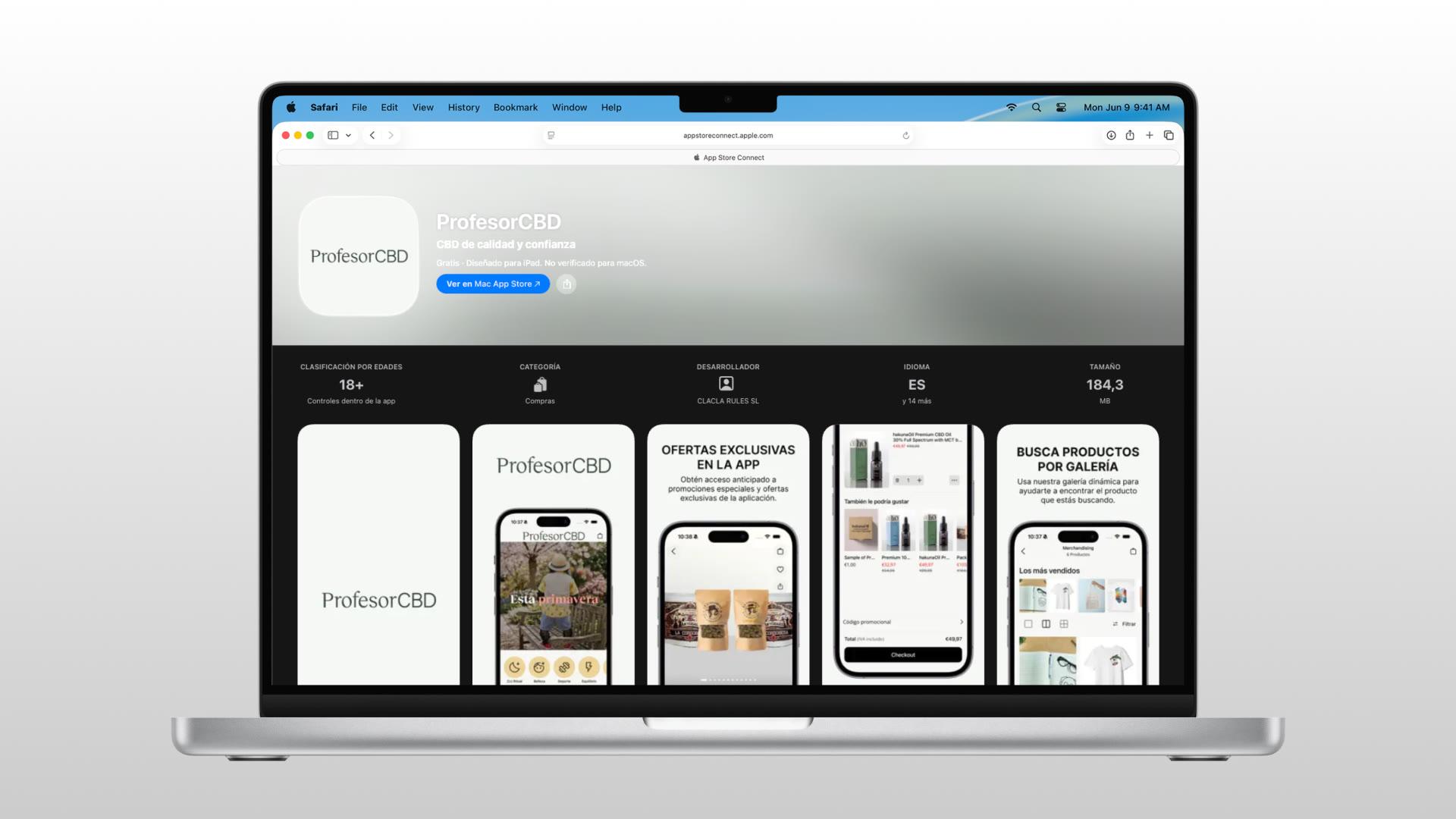
Profesor CBD, a licensed Spanish CBD brand, was approved for the App Store after a review tailored to its products, markets, and account. Getting there involved more than one control:
- It removed all of its vape products from the app's sale channel. Vape and nicotine products aren't permitted, so those SKUs came out of the app entirely, even though the brand sells them through other channels.
- It provided its full Spanish licensing documentation to prove to Apple that it is licensed to sell controlled substances, as a legal entity rather than an individual developer (the situation Guidelines 1.4.3 and 5.1.1(ix) speak to).
- Its shopping experience was geo-restricted so it operated only where the products are legally sold.
Licensing evidence, removing prohibited products, and geo-restriction were parts of one successful submission. This outcome does not establish a general App Store route for CBD or cannabis brands. It says nothing about Google Play, other markets, or a different product mix. Your review will turn on your products, licensing, and jurisdictions.
What geo-restriction is, and what it is not
Geo-restriction limits app features by the user's region, so a shopping experience works only in the areas you choose. Apple requires it for legal cannabis sales. Guideline 5.1.1(ix) says those apps must be geo-restricted to the corresponding legal jurisdiction.
Geo-restriction is not proof of compliance. It does not establish licensing, age verification, identity checks, shipping compliance, product legality, advertising compliance, or tax position. It does not guarantee store approval. Treat it as one control that counsel and the platform may require.
What this means before you build
The order of operations for a regulated brand:
- Answer the "pin down" list above with your real product composition, jurisdictions, and licensing.
- Get legal advice on whether the model is lawful to market, sell, ship, and advertise in each market.
- Get a written determination from each store for your exact model, especially anything borderline. A general guide cannot substitute for this.
- Only then scope the app, shaped to whatever those answers allow, which may mean a narrower app than you first imagined, or none on a given store. Once you have a scope, our Shopify mobile app launch checklist covers the steps common to every launch, regulated or not.
Rules change and the details decide the outcome. Start with an assessment, not a build.
How NAPPS helps
NAPPS publishes Shopify and Shopify Plus apps from your Apple and Google accounts. We can build controls regulated brands may need, including geo-restriction. We can explain the published store rules and build the app to match the constraints you establish. We cannot make a legal determination or guarantee a store decision. You must secure licensing, legal advice, and written policy determinations.
For the listing and metadata rules that apply to every app, regulated or not, see our guide on filling in your store listing /blog/app-store-listing-rejection-guide.
Frequently asked questions
It depends on the product and the store, and it can't be predicted from the published policies. Google folds THC-containing CBD into its marijuana restriction, and neither store publishes a test for THC-free CBD. A licensed brand may be approved (Profesor CBD, a licensed Spanish CBD brand, was approved on the App Store after submitting its licensing and geo-restricting the experience), but that is one outcome, not a general route. Confirm treatment of your specific products in writing.
On Apple, only under specific conditions: Guideline 1.4.3 limits the exception to licensed pharmacies and licensed or legal cannabis dispensaries, and 5.1.1(ix) requires the app to be submitted by a legal entity and geo-restricted to the legal jurisdiction, decided case by case. Google does not allow apps that facilitate the sale of marijuana or marijuana products regardless of legality, and moving checkout to the web or linking out is not a safe workaround, because a link-out can still facilitate a sale. Get a written determination before building.
Generally no. Both stores prohibit apps that facilitate the sale of vape, e-cigarette, or nicotine products. Google notes narrow exceptions that do not make a dedicated vape brand's app viable. Plan on the assumption that a transactional app isn't available, and verify for your case.
No. It's one potential technical control. It does not establish licensing, age verification, shipping compliance, product legality, or a store's approval, all of which are separate. Treat it as one piece that counsel or a store may require, not as proof of compliance.
Yes, significantly, and they change often. Store policy sits on top of local law, so the answer depends on your products, licensing, and markets. Verify current policy and take legal advice before building.
Straight from the source
Check the current versions directly, since these policies change:
- Apple: the App Store Review Guidelines (controlled substances and tobacco under 1.4.3; regulated-field submitter and cannabis geo-restriction rules under 5.1.1(ix)).
- Google: the Developer Program Policy, covering restricted content including marijuana and tobacco/nicotine.
The bottom line
For regulated products, test legal and platform viability before discussing growth. Apple has a conditional, case-by-case path for licensed cannabis dispensaries. Guidelines 1.4.3 and 5.1.1(ix) require a legal-entity submitter and geo-restriction to legal jurisdictions. Google prohibits facilitating marijuana sales regardless of legality, with no safe web-checkout workaround. Vape and nicotine commerce apps are generally unavailable on either store. CBD depends on THC content and a written determination, not simply the policy text. Profesor CBD's approval shows one specific outcome, not a general route. Start with counsel and the stores, not a build.
If your products sit in one of these categories, talk to the NAPPS team for an honest read on store viability and how an app could be structured, so you can take that into your legal and platform conversations before you build.
Get a straight read before you build
We'll walk through what Apple and Google publicly say about your category, and how an app could be structured once your licensing and jurisdictions are pinned down.
Book a 20-minute callKeep reading
October 27, 2026 - 10 min read
4 MobiLoud alternatives for Shopify: pricing and fit


October 23, 2026 - 8 min read
Tapcart vs Shopney: pricing, features, and which fits your Shopify store
September 18, 2026 - 13 min read
Tapcart Alternative: NAPPS Pricing, Features & Migration