

Friday, July 10th 2026
How to grow a Shopify mobile app: acquire, activate, retain

To grow a Shopify mobile app, run a three-stage loop continuously: acquire installs from the audience you already own, activate each new user into a first purchase, and retain them with reasons to return. Launching takes weeks. This loop is what separates apps that reach a third of online revenue from those that stall at a few percent.
This guide covers the case for the channel, each stage of the loop, and real customer figures.
Why a mobile app is worth growing
A mobile app matters because customer acquisition keeps getting more expensive while attention has consolidated onto one device: the phone. Most brands spend heavily to acquire a customer on mobile, then send them to a mobile website that behaves like a transactional endpoint. The session ends. The relationship resets. The next visit costs money again.
An app breaks that pattern. It gives a brand four things more reliably and with less friction than a mobile site:
- Owned reach. Push notifications land on the home screen, with no inbox to compete with, and they reach customers you don't have an email or phone number for. They're also free to send: push runs on the platforms' own infrastructure (Firebase Cloud Messaging, Apple Push Notification service), with no per-message cost like SMS.
- A persistent relationship. The app stays installed between visits. Sessions, carts, and logins carry over, so personalization does not restart from scratch.
- A faster experience. Native navigation is quicker and smoother than a browser. Customers view more products per session, which means more chances to convert and larger baskets.
- Less dependence on reacquisition. When you can reach customers directly, you rely less on paid ads to bring them back.
The core idea behind all of it:
Mobile web optimizes transactions. Apps optimize relationships.
NAPPS customer data shows that brands actively running push, loyalty, and app-only content have seen 15% to 45% of online revenue come through the app in the first months after launch. Zippy, Portugal's largest children's fashion brand, reached roughly 34% of total online revenue through the app within seven months.
An app isn't equally suited to every business, though. It performs best for brands with a repeat-purchasable product, an existing base of loyal customers, and a reason to come back (drops, restocks, promotions, new collections). If you're still weighing whether the timing is right for your store, we've covered the readiness signals in depth in when to launch a Shopify mobile app.
The growth loop: acquire, activate, retain
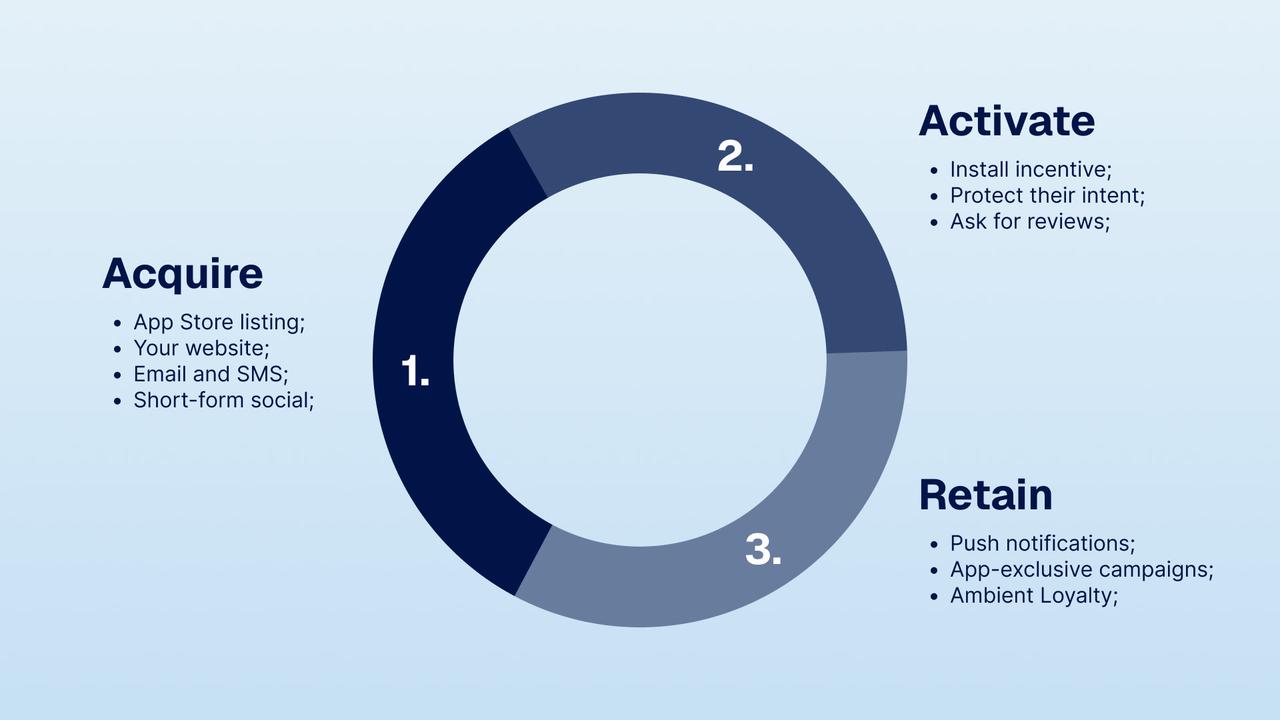
Every strong commerce app moves through three repeating stages. Adoption does not end on launch day. It needs ongoing work:
- Acquire: turn your existing customers into app users.
- Activate: get each new user to their first in-app purchase quickly.
- Retain: bring them back with push, exclusives, and loyalty, without paid re-acquisition.
Focus on your existing customer base first. Most app growth comes from converting people who already buy from you, not from attracting new shoppers through the App Store. New customer acquisition is a bonus.
Acquire: turn the audience you own into installs
Every acquisition tactic is a different way of putting the same offer in front of customers who already trust you. The main channels:
- Your App Store listing. Treat it like a landing page: use a clear name with an intent keyword, a sharp subtitle, and screenshots and description that explain the benefits. Most brands set it once and never touch it again, which loses installs.
- Your website. Use a smart app banner on mobile ("Get 10% off in the app" converts better than "Download our app"), a QR code for desktop shoppers, and deep links so existing links open in the app rather than a slower mobile web page.
- Email and SMS. Segment your list and give each group a reason to install. Web buyers who have not installed get the exclusive benefits, recent purchasers get faster checkout and loyalty points, and lapsed app users get an update on what is new.
- Short-form social. A launch is a moment, and short-form video builds attention around it. Mamba Store planned a single launch video for their app release and it gathered more than 20,000 impressions, turning that attention into installs.
App Store search ads are a fifth option, but they are optional. Converting existing customers is usually cheaper and more reliable than paying for new installs.
Preparing all of these assets (the listing copy, the announcement sequence, the social content) is its own project, and we've broken it down item by item in the Shopify mobile app launch checklist.
Activate: from download to first purchase
A download is not adoption. Activation means getting each new user to their first in-app purchase quickly, because the first session sets the habit. Three things drive it.
Give them a reason with an install incentive
A short-term incentive jump-starts adoption, especially for customers who need a reason to add one more app to their phone. The options that work: a first-install discount, a loyalty point multiplier, free shipping in the app, or early access to a sale.
More Shopify brands are using store credit. A discount reduces the current order. Credit gives the customer a balance they can spend only with you, giving them a reason to return. Brands use it in a few ways:
- A welcome deposit. Credit arrives when a customer opens the app and logs in for the first time.
- More credit for app purchases. Buying in the app earns more credit back than buying on the website.
- Refunds as boosted credit. Offer a bonus when a customer accepts store credit for a return.
Protect their intent
When a customer taps a product link in your email, SMS, or social and has the app installed, they should land on that product inside the app, logged in, cart intact. Every redirect to the slow mobile web path is a chance to lose the sale. Pair deep links with a clean onboarding flow (market selection, push opt-in, account creation) so the first session ends at checkout, not at a login wall.
Ask for the review at the right moment
Higher ratings generally lift your App Store ranking and make the next install cheaper. Apple only lets you prompt a user three times in a 365-day period, and its system decides whether the prompt actually shows, so timing matters. A sensible moment to ask is right after the first purchase, while the experience is fresh; treat the exact timing as something to test.
Retain: where the repeat revenue lives
Retention is what turns the app from a sales channel into a relationship, and it runs on three engines.
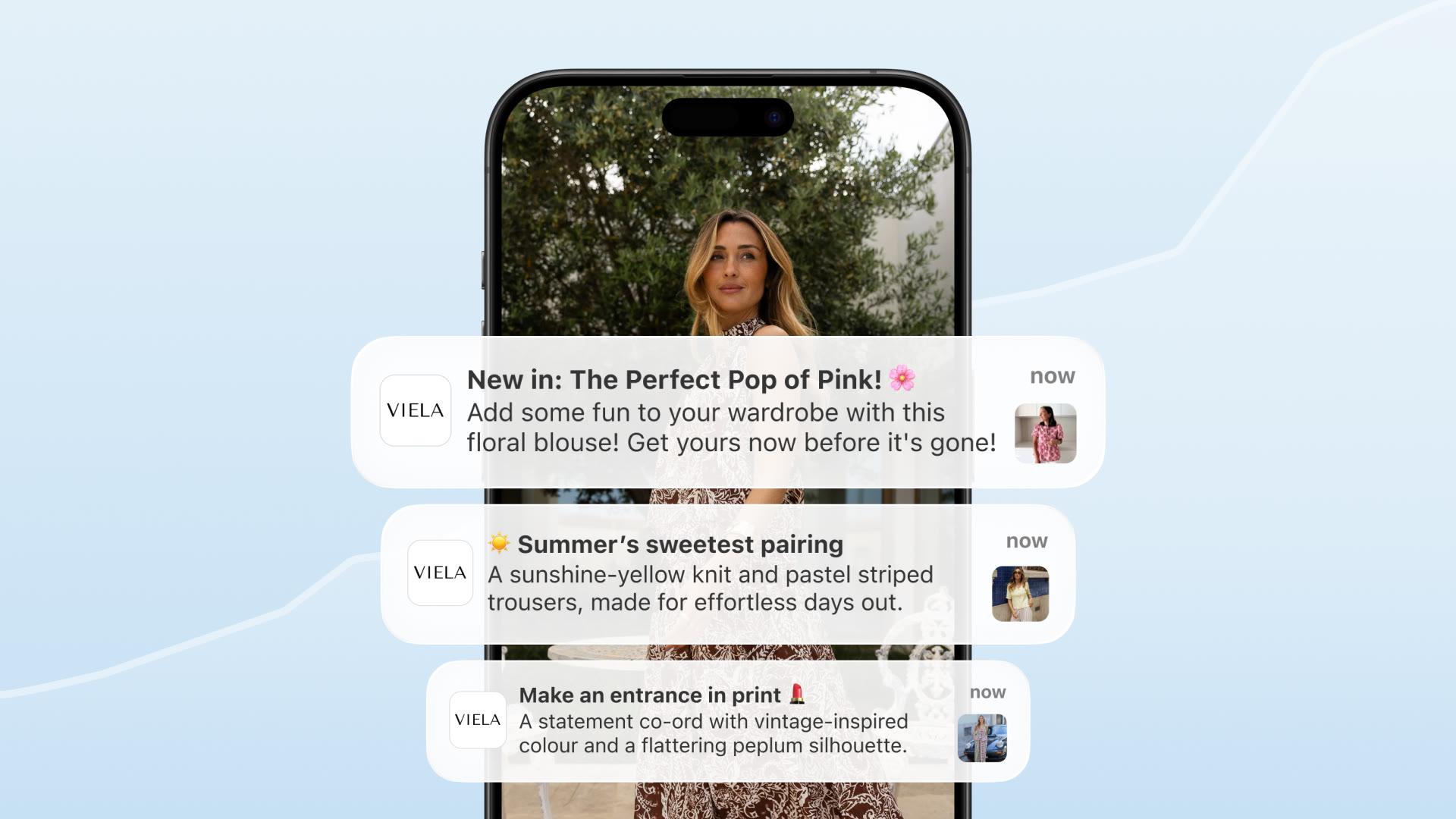
Push notifications. In our experience, one of the highest-engagement owned channels you have: it lands on the lock screen, competes with no inbox, is free to send, and is one tap from conversion. A complete program has two halves, always-on automations (welcome series, abandoned cart, back-in-stock, order status, price drops) and campaign pushes for the moments you create. We've written a full guide to building the push-notification program.
App-exclusive campaigns. When something is only available in the app (a product, a price, or early access), downloading becomes a value decision instead of an effort decision. Proven formats: early access drops for VIP segments, app-only pricing, and even password-gating the whole app before a launch to build anticipation. Gate the app, never the website: locking a storefront looks sloppy, while locking an app reads as exclusive.
Visible loyalty. Most loyalty programs underperform because customers find them only after logging in, away from the purchase. In an app, show points while customers browse, let them redeem rewards in the cart, and keep the program one tap away in the bottom navigation. That visibility encourages customers to use their balance.
The mechanics that turn these three engines into a repeated habit are covered in Mobile app retention strategy: how to build a return loop.
At scale. One app-only campaign gave Zippy the highest online sales day in the brand's history, ahead of Black Friday and Christmas. It reached only customers who had opted in, through one channel, with no coordinated multichannel spend.
What the numbers look like
All figures compare the app channel against the online storefront, from real NAPPS customers on Shopify and Shopify Plus. Results vary by category and by how actively each brand runs push, exclusives, and loyalty, but the pattern is consistent:
| Metric | Across NAPPS customers |
|---|---|
| AOV lift (app vs storefront) | +5% to +38%, positive for every customer tracked |
| 90-day spend per customer | +17% on average |
| App conversion rate | 5x to 6x versus the website, about 4.7x versus mobile web |
| App share of online revenue | 15% to 45% within the first months, when the retention program is running |
A few of the brands behind those ranges:
- Zippy (children's fashion). Roughly 34% of online revenue came through the app in seven months, while combined digital revenue was up 15% year over year. That is consistent with the app adding growth rather than shifting it, but it is one case and not proof.
- Planeta Huerto (organic food). Spend per customer was up 47%, with a 72% repeat-purchase rate.
- Farma2Go (online pharmacy). AOV was up 38%, and 90-day spend per customer was up 77%.
- Missus (swimwear). Five years after launch, the app still accounts for roughly 30% of online revenue. App customers spend 47% more each and return at 44.20%, compared with 33.63% on the website.
If you want the month-by-month version of how those numbers build, we've mapped the whole first quarter in what to expect in your first 90 days with a Shopify mobile app.
How NAPPS fits in
NAPPS, a native mobile app builder for Shopify and Shopify Plus brands, is built around this exact loop. The apps are genuinely native (SwiftUI on iOS, Jetpack Compose on Android), the acquisition tooling (App Store listing setup, smart banner, QR codes, deep links) is built in, push is unlimited on every plan, and app-exclusive campaigns run through Campaign Launcher with loyalty surfaced in the shopping flow through Growave, LoyaltyLion, or Smile.
And the risk is low by design: the app is free until you're ready to publish, with no setup fee. If you're switching from another provider, we'll match the time left on your current contract, and those months are on us.
FAQ
Convert the audience you already own. Announce through segmented email and SMS, wire your website with a smart app banner, desktop QR code, and deep links, make the launch a moment on social, and anchor everything on one install incentive. Existing customers, not App Store strangers, are where app growth comes from.
Store credit is the strongest play right now among Shopify brands: a credit deposit that lands on first login, or extra credit back on app purchases. Unlike a discount, credit can only be spent with you, so it guarantees a return visit. Discounts, loyalty point multipliers, free shipping, and early sale access also work.
Based on NAPPS customer data, brands actively using push, loyalty, and app-exclusive content see 15-45% of online revenue shift to the app within the first months. Zippy reached roughly 34% of total online revenue within seven months of launch.
No. Plenty of brands run a highly successful app without ever touching paid installs. Converting your existing customers through email, your website, and social is cheaper and more reliable. Search ads are an optional extra for squeezing out incremental net-new installs.
The bottom line
Growing a Shopify mobile app requires more than a launch. Bring in installs from the audience you already own, drive the first purchase quickly, and use push, app-only offers, and loyalty to bring customers back from day one. Brands that do this work give the app a chance to become their highest-spending channel. Brands that stop at upload do not.
This guide is the condensed version. The full App Growth Playbook goes deeper on every strategy, with the complete benchmarks and launch checklist.
See the growth loop on your own store
The full playbook goes deeper on every stage of the loop. If you'd rather see it on your own numbers, we'll map your traffic, repeat-purchase rate, and customer base into a projected launch plan first.
Book a 20-minute callKeep reading
October 27, 2026 - 10 min read
4 MobiLoud alternatives for Shopify: pricing and fit


October 23, 2026 - 8 min read
Tapcart vs Shopney: pricing, features, and which fits your Shopify store
September 18, 2026 - 13 min read
Tapcart Alternative: NAPPS Pricing, Features & Migration